Selling Surplus Lab Equipment: How to Get the Best Value
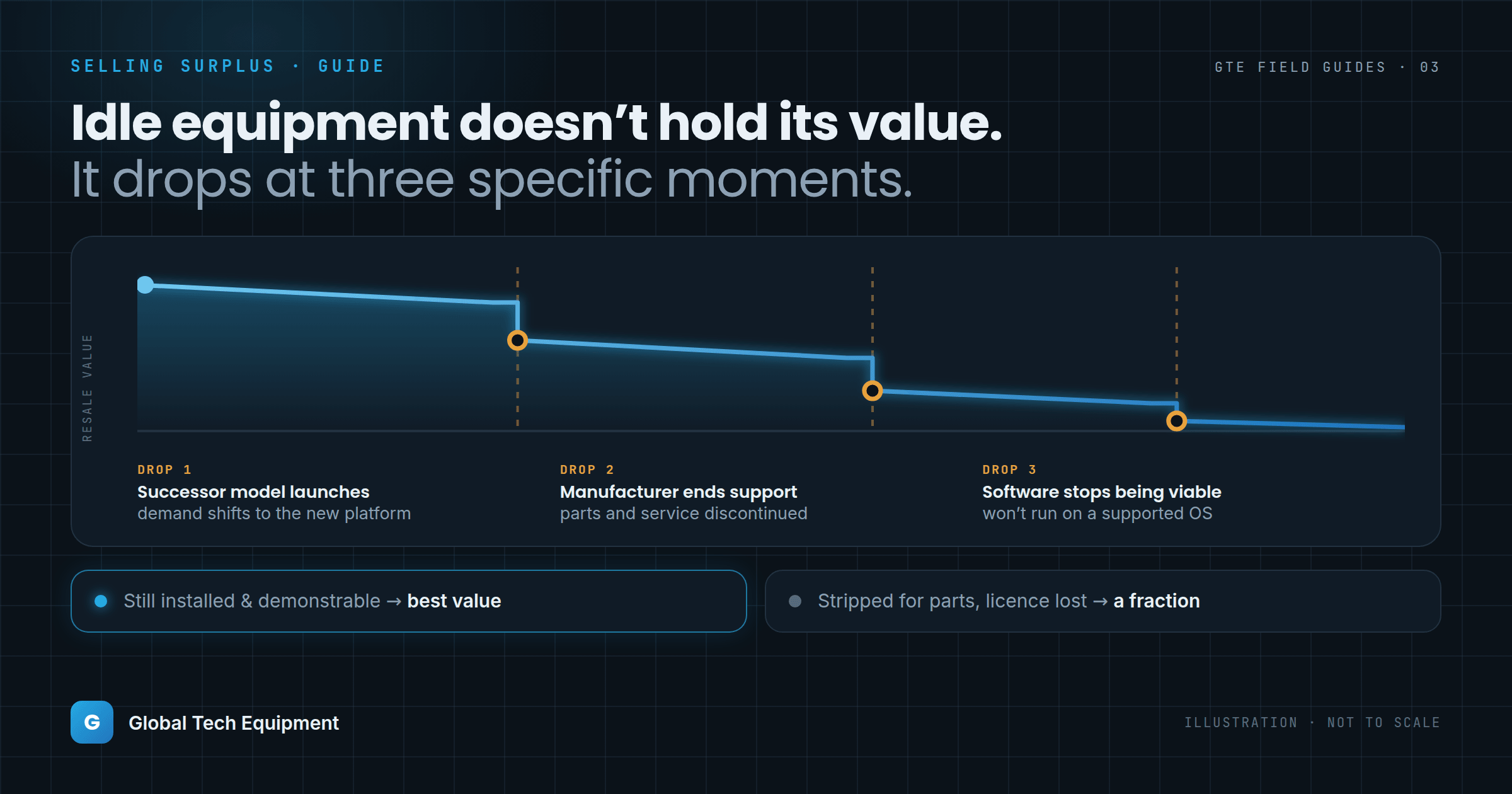
An instrument sitting idle in a corner is not holding its value. It's on a curve, and the curve goes one direction.
Whether you're closing a lab, consolidating after a merger, upgrading a platform, or clearing a room you need back, a little preparation reliably adds meaningful money to what you net. Here's what actually matters.
Time is the biggest single factor
Most people wait too long. The instrument comes offline, gets pushed against a wall "until we decide," and two years later it's worth a fraction of what it would have brought.
Value drops fastest at three specific moments:
- A successor model launches. Demand shifts to the newer platform and your model's market thins.
- The manufacturer ends support. Once parts and service are officially discontinued, the buyer pool narrows to those comfortable self-supporting.
- The software stops being viable. An instrument whose control software only runs on an unsupported operating system is much harder to sell into a regulated lab.
None of these are things you control — but the sooner you move relative to them, the better you do.
If an instrument has been idle for six months and there's no concrete plan to use it, it's costing you money to keep. Floor space isn't free, and the resale curve isn't waiting.
What actually drives the price
Working condition, demonstrated. An instrument that can be powered up and shown running is worth substantially more than the identical unit described as "was working when we removed it." If it's still installed, get it demonstrated before de-installation.
Completeness. This is where most value quietly disappears. The instrument alone is worth less than the instrument with its autosampler, detectors, computer, software, manuals, install kit, spare parts, and accessories. A GC-MS with its tower and tray is a different product from a bare GC-MS.
Software and licensing. Confirm you can transfer the licence, and find the dongle, keys, and installation media. An instrument with an untransferable licence is worth materially less, because the buyer has to purchase software before it does anything.
Service history. A recent preventive maintenance visit, a service contract history, or a recent tune or performance report is real leverage. It converts "probably fine" into evidence.
Vintage and configuration. Model year, options, source and detector types, and installed upgrades all move the number.
Photographs. Clear photos — the whole unit, the model and serial plate, the screen powered on, the accessories laid out — get you better offers faster, because the buyer isn't pricing in uncertainty.
Your options, compared
There's no single right answer; it depends on how fast you need it gone and how much effort you want to spend.
| Option | Speed | Certainty | Typical net | Effort for you |
|---|---|---|---|---|
| Direct purchase (we buy it outright) | Fastest | Highest — agreed price, paid | Lower gross, no downstream risk | Minimal |
| Consignment | Slower | Depends on the market | Often the highest net | Low, but you wait |
| Brokerage | Medium | Medium | Good | Low |
| Auction | Fast for whole lots | Market decides on the day | Lowest per unit, best for volume | Medium |
| Trade-in | Fast | High | Applied against a purchase | Minimal |
Direct purchase suits a hard deadline — a lease ending, a building closing, a room that has to be empty by a date.
Consignment suits patient sellers with desirable equipment: you keep more of the final sale price but accept that it sells when it sells.
Auction makes sense when there's a lot of it and a firm deadline. Expect volume speed, not maximum per-unit value.
Gather this before you ask for an offer
You'll get a faster and better offer if the first message contains:
- Make, model, and serial number — plus year if you know it.
- Configuration — detectors, sources, columns, autosampler, options, upgrades.
- Working status — when was it last run? Last PM or service visit?
- Software — package, version, and whether the licence can transfer.
- Photos — full unit, model/serial plate, powered-on screen, accessories.
- Location and access — floor, elevator, door widths, dock or no dock.
- Timeline — when it needs to be gone, and whether de-installation is required.
- Decontamination status — see below.
That list is roughly the difference between a cautious offer and a confident one.
Decontamination and documentation
If an instrument has been used with biological, chemical, or radiological materials, it needs proper decontamination and documentation before it can be moved or resold. Say so early — it isn't a dealbreaker, it's a logistics step, and surfacing it up front avoids a deal collapsing late.
Regulated environments may also require you to retain or wipe data on the attached computer. Sort that before the PC leaves the building.
The mistakes that cost the most
Cannibalizing it for parts first. Pulling a detector or a board off a working instrument to fix another one converts a saleable system into a much cheaper parts unit. If you might sell it, don't strip it.
Losing the software, keys, or manuals. These get separated during a move and are disproportionately expensive to replace.
Scrapping without asking. Scrap value on analytical instruments is a small fraction of resale value. Get a quote before anything goes to metal recycling — the difference is frequently thousands.
De-installing before documenting. Once it's on a pallet in shrink-wrap, nobody can demonstrate that it works. Photograph and demo it while it's still running.
Splitting up the accessories. Keep the system together. Autosamplers, spares, and install kits sold or discarded separately reduce the total substantially.
Waiting for a better market. For most instruments there isn't one coming. The curve trends down.
What logistics do to your net
Rigging, crating, and freight are real costs, and who absorbs them shapes your final number. Ask any buyer to be explicit about:
- Who de-installs, and whether that requires a manufacturer engineer
- Who rigs and loads
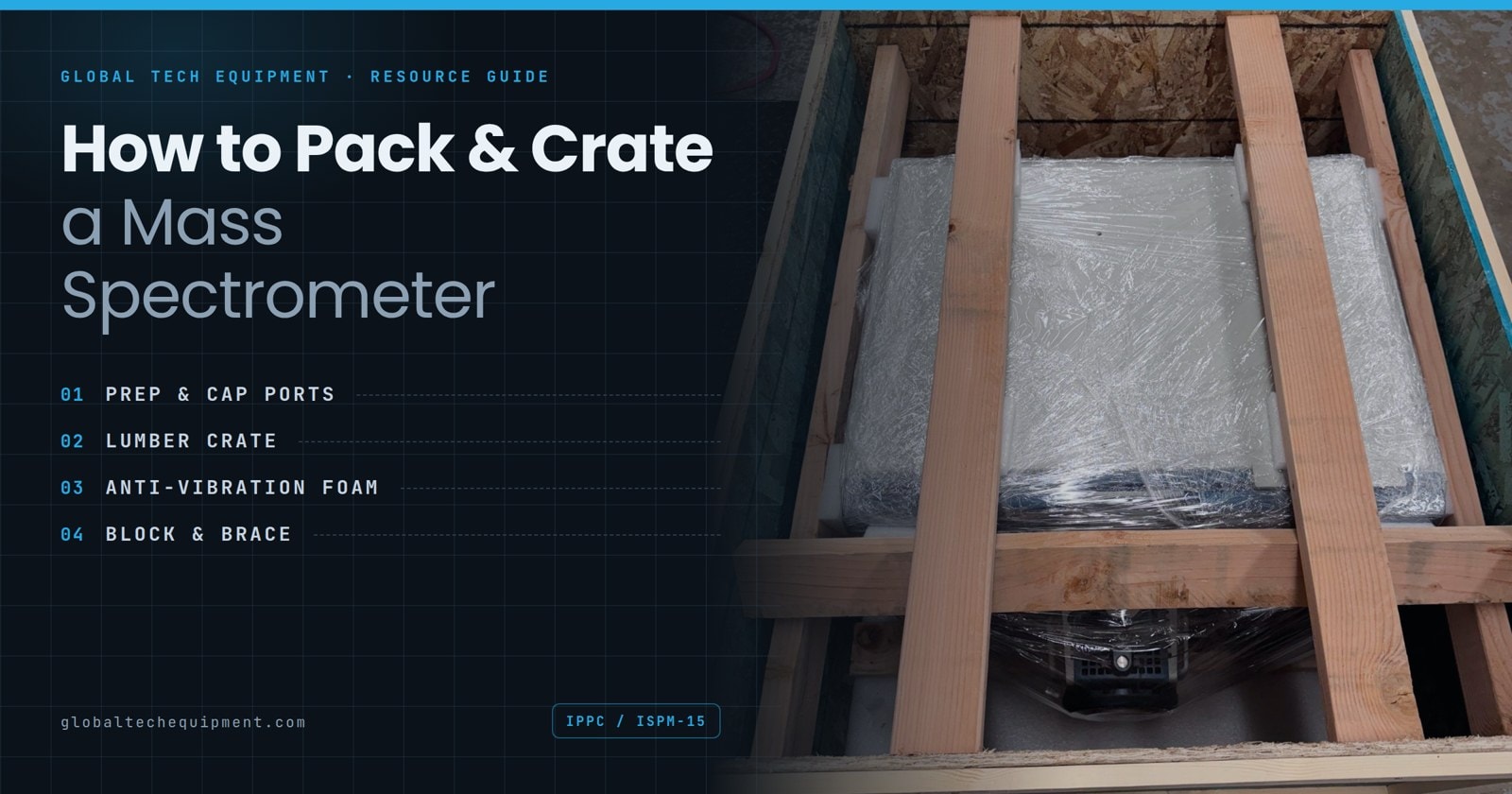
- Who crates, and to what standard — export shipments require heat-treated IPPC/ISPM-15 lumber
- Who pays freight and insurance
A slightly lower offer with all logistics handled can net you more than a higher one where you're arranging riggers yourself.
How it works with us
We've bought, sold, and traded used analytical and lab instruments since 2013, and we handle rigging, crating, shipping, and warehousing in-house — so a sale is dealt with end to end rather than handed off in pieces.
Send us the details and photos, and we'll come back with a straight answer on what it's worth and which route makes sense — direct purchase, consignment, brokerage, or auction. If we're not the right buyer, we'll tell you that too.