How to Pack and Crate a Mass Spectrometer
A mass spectrometer can run for years in a climate-controlled lab and then face the most dangerous week of its life: the truck. In our experience, instruments that arrive damaged were almost always hurt by their packaging, not by the carrier. The crate decides.
This is the process we use in-house at Global Tech Equipment, shown here on a SCIEX QTRAP 6500+ we recently crated. The same steps apply to any benchtop LC-MS/MS or GC-MS — and, scaled up, to most floor-standing instruments.
1. Prep the instrument
Start at the bench, before any lumber is involved:
- Disconnect everything — power cables, data cables, solvent lines, gas lines, exhaust hoses. Don't ship an instrument with anything still attached.
- Cap open vacuum and gas ports. Aluminum foil taped over each port is the accepted standard: it keeps dust and debris out of the analyzer during transit without leaving adhesive residue on sealing surfaces.
- Box any loose or small pieces — probes, source parts, cables, fittings. Bag them, box them, label the box, and ship it inside the crate. Small parts left loose are the first thing lost in a move.
- Shrink-wrap the instrument. It holds panels and doors closed and keeps moisture and grit off during handling.
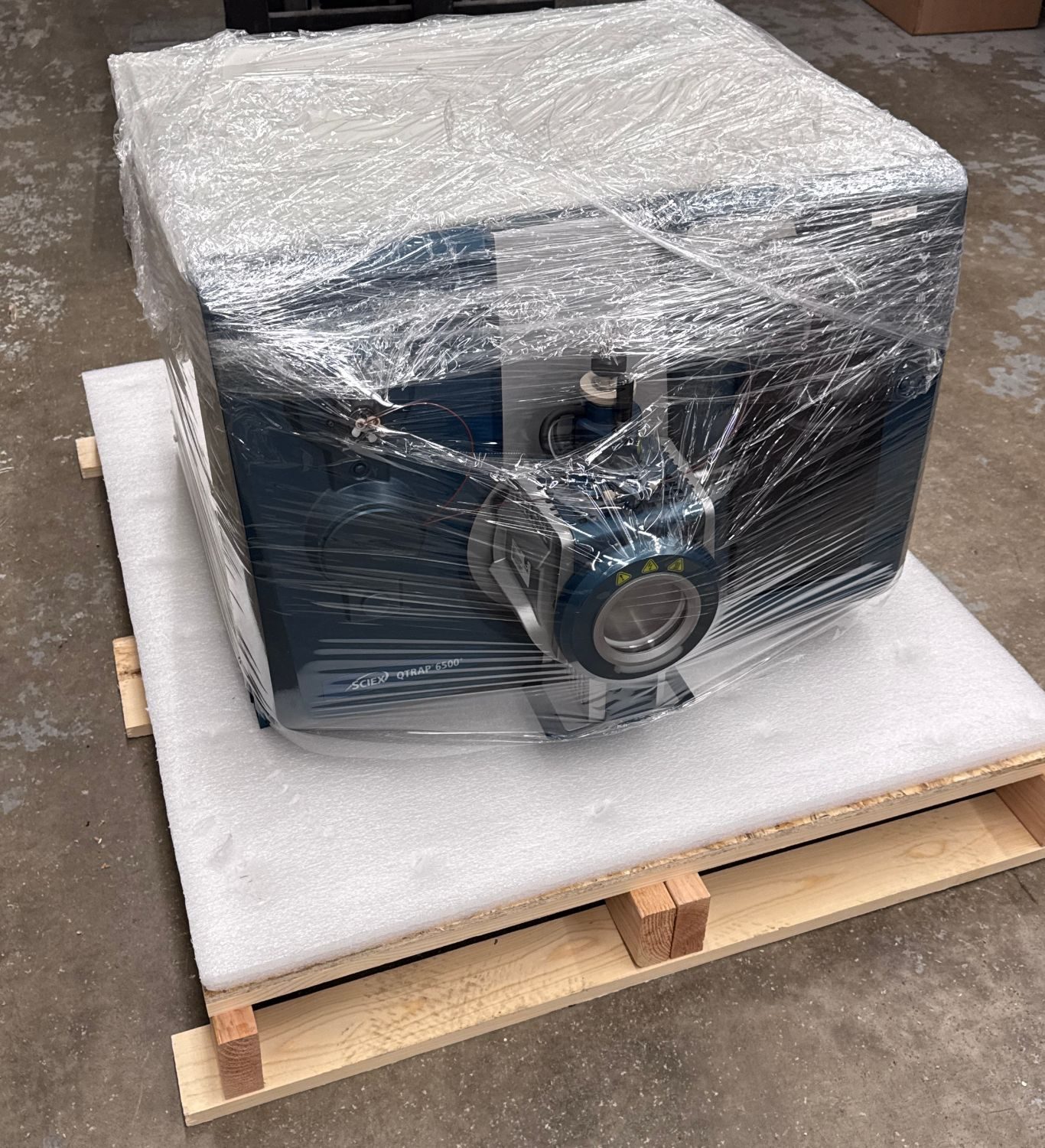
A QTRAP 6500+ prepped and wrapped, resting on its foam pad on the crate base — ports capped, loose parts boxed separately.
2. Build (or buy) a real crate
A mass spectrometer needs a sturdy lumber crate with forklift entry — skids tall enough for forks, because nothing this heavy should ever be lifted by hand or slid across a truck bed.
If crate-building isn't your trade, two good options:
- Hire a local crating company. Most metro areas have one; they'll build to your instrument's dimensions and weight.
- Build from a cut-sheet template. Free crate cut sheets are easy to find online and a competent shop can build one in an afternoon.
Either way, plan extra interior space — the crate must be larger than the instrument to leave room for the foam beneath it and the blocking and bracing around it. A crate the instrument barely squeezes into can't protect it.
3. Foam under the instrument
Line the crate floor with anti-vibration foam before the instrument goes in. Road vibration is constant for the entire trip, and it's exactly the kind of energy precision optics, turbo pumps, and quadrupole assemblies dislike. A foam layer between the crate base and the instrument's feet absorbs it.
4. Block and brace
This is the step most self-packed shipments skip, and it's the one that matters most: the instrument must not be able to move inside the crate.
Cut 2×4s to the inside dimensions of the crate and fit them snugly against the instrument on each side. Then secure each brace with screws driven from the outside of the crate walls. Braced this way, the instrument, the bracing, and the crate move as a single unit — a hard stop or a rough forklift transfer can't turn the instrument into a projectile inside its own box.
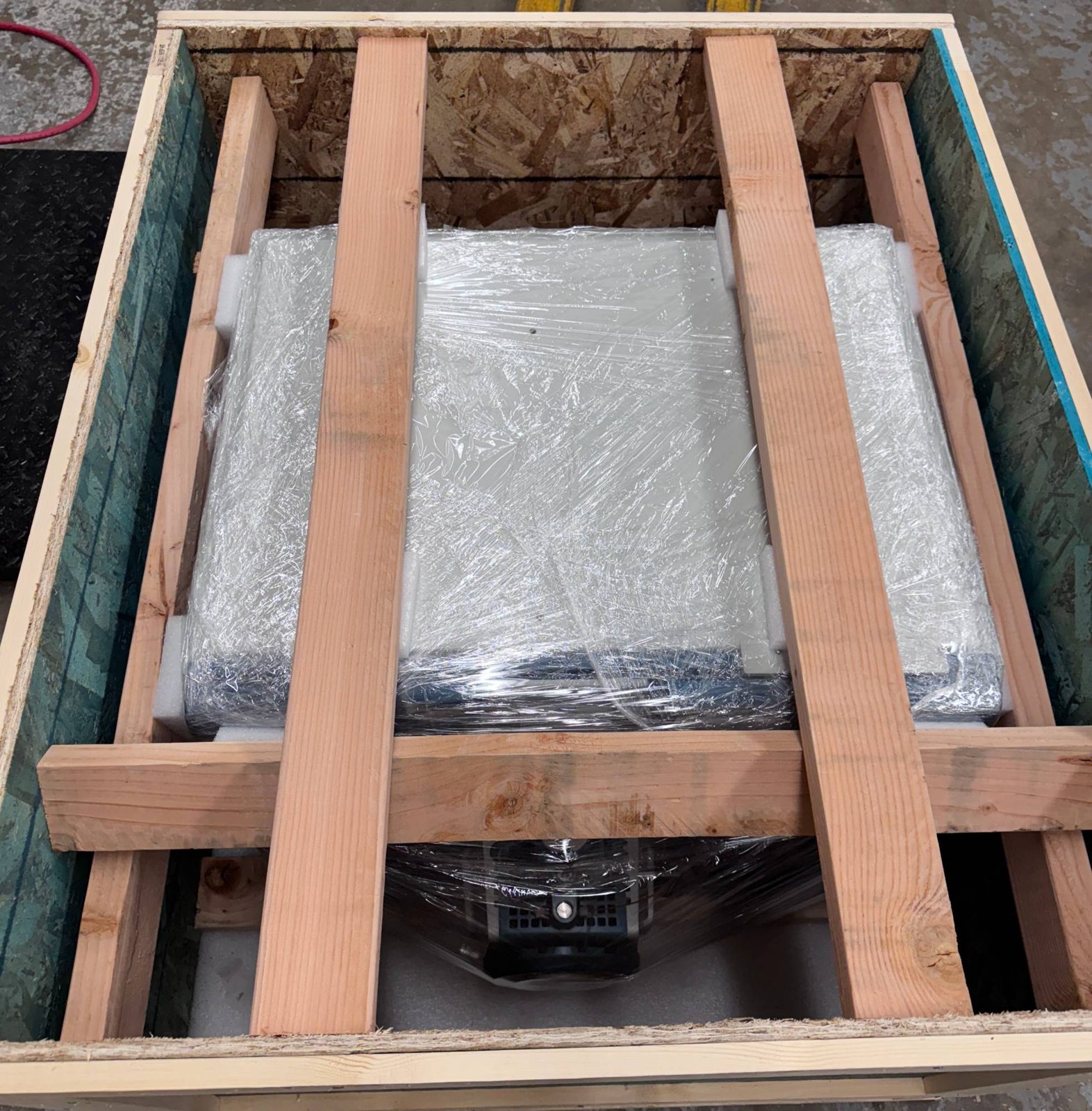
The same instrument blocked and braced: 2×4s cut to the crate's inside length, screwed through from outside the walls.
5. Shipping internationally? Use IPPC-stamped lumber
If the crate is leaving the country, it must be built from heat-treated lumber carrying the IPPC / ISPM-15 stamp — the international phytosanitary standard. Customs can reject or destroy an unstamped crate at the border, instrument and all. Domestic shipments don't need it, but decide before the crate is built; you can't stamp it afterward.
Planning is the whole game
None of these steps is difficult. What they have in common is that every one of them has to be decided before the wrap goes on — the crate size, the foam, the bracing, the lumber grade. Relocating an expensive instrument goes well when the whole trip is planned in advance, and badly when it's improvised at the loading dock.
Or let us handle it
We crate every instrument we ship the same way you see above — custom lumber crates, anti-vibration foam, block-and-brace, IPPC-stamped lumber for export, all in-house.
If you're selling an instrument, freight and crating are part of every deal we do. Have a relocation question? Get in touch — we're happy to point you in the right direction.