Single Quad or Triple Quad GC-MS? What the Upgrade Actually Buys You
If you're shopping for a GC-MS, you'll quickly hit a fork: a single quadrupole (Agilent 5975, 5977 and similar) or a triple quadrupole — GC-MS/MS (Agilent 7000, 7010 and similar).
The common assumption is that a triple quad is just a more sensitive single quad, so you buy one if you need lower detection limits. That's not quite right, and the misunderstanding leads to expensive mistakes in both directions.
Here's what the upgrade actually buys you.
The real difference is selectivity, not raw sensitivity
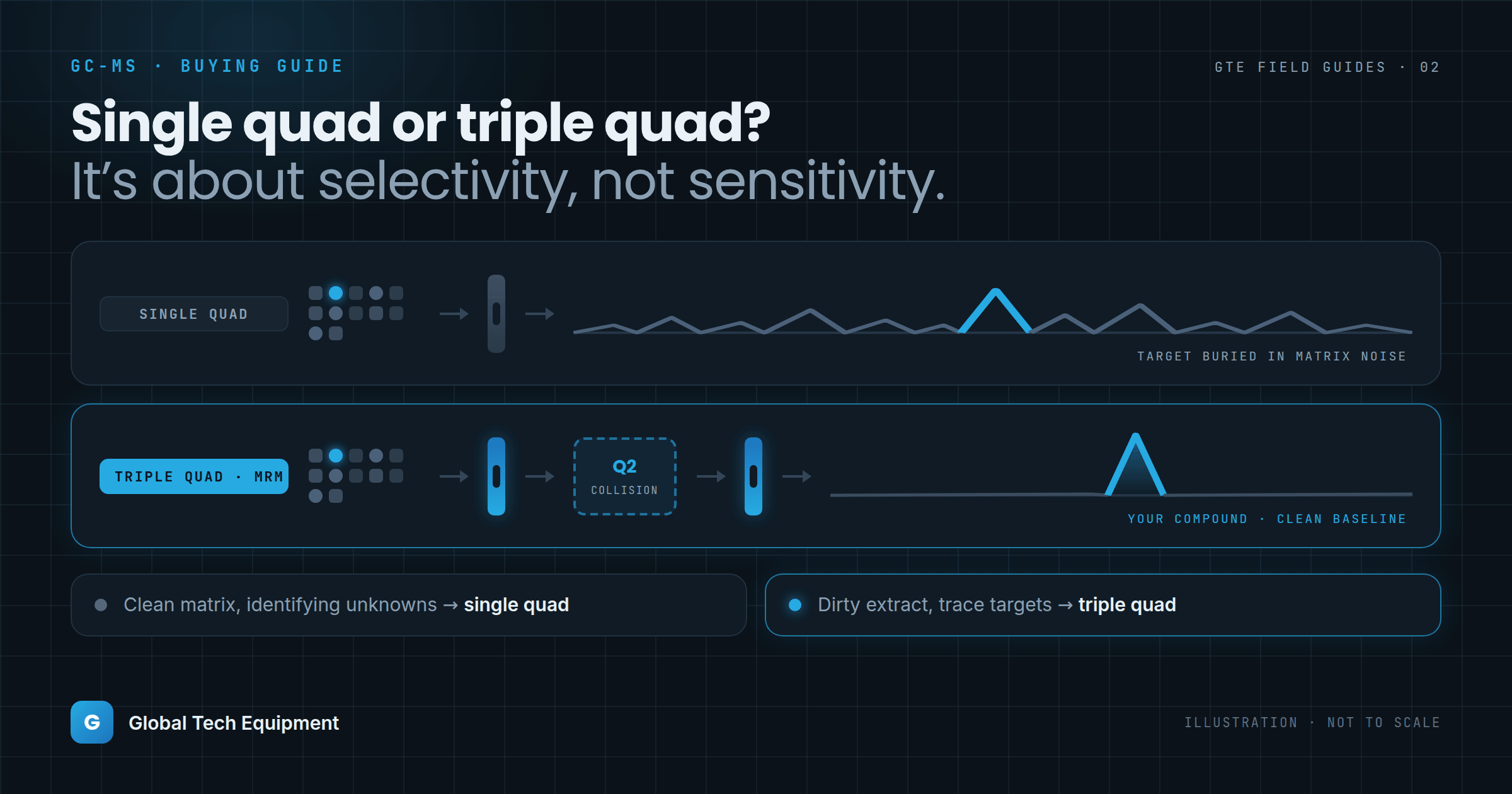
A single quadrupole filters ions by mass. In full scan it collects whole spectra you can search against a library like NIST — which is what makes it good at identifying unknowns. In SIM (selected ion monitoring), it watches only chosen ions, improving signal-to-noise for known targets.
A triple quadrupole runs MRM (multiple reaction monitoring). It selects a precursor ion in the first quadrupole, smashes it in a collision cell, and watches for a specific product ion in the third. A compound only counts if it produces that fragment from that precursor at that retention time.
That two-stage filter is the whole point. It doesn't make your compound produce more signal — it removes almost everything that isn't your compound.
The upgrade buys you a cleaner baseline, not a bigger peak. In a clean solvent standard, the two instruments may perform similarly. In a dirty extract, the triple quad wins enormously — because what limits your detection limit in real samples is chemical noise from the matrix, not detector sensitivity.
This is why the honest question isn't "how low do I need to go?" but "how dirty is what I'm injecting?"
Choose a triple quad when…
Your matrix is complex. Food and agricultural extracts, botanical and cannabis products, soil, plasma and tissue, wastewater. Anywhere QuEChERS or a dirty solvent extract goes into the inlet, a single quad's baseline fills with co-extracted junk that MRM simply ignores.
You run large target panels. Pesticide residue work routinely covers hundreds of analytes in one method. Scheduled MRM — where transitions are only monitored near their retention windows — lets you run panels that would be impractical in SIM without losing dwell time.
You quantify at trace levels in real samples. Low-ppb and sub-ppb quantitation in matrix is where the technique earns its price.
A customer or method requires it. Some residue and contaminant programs effectively assume MS/MS confirmation, since the two transitions (quantifier and qualifier) provide identification confidence a single ion can't.
Choose a single quad when…
You're identifying unknowns. This matters and gets forgotten. Full-scan spectra searched against NIST are how you find out what something is. A triple quad is a targeted instrument — brilliant when you know what you're looking for, less useful when you don't. If your work is "what's in this?", a single quad is the right tool.
Your matrices are relatively clean. Solvent standards, purified extracts, headspace and purge-and-trap volatiles. If matrix noise isn't your limiting factor, MRM solves a problem you don't have.
Your limits are moderate. Plenty of QC, residual solvent, and screening work sits comfortably at levels a single quad handles in SIM.
You want a simpler instrument to own and staff. Method development on a triple quad means optimizing precursor and product ions and collision energies for every analyte. That's real work and real expertise. A single quad method is faster to build and easier to hand to a new analyst.
Cost of ownership
The two share most of their running costs — and people underestimate how much.
Shared: GC columns, inlet liners, septa, ferrules, gold seals, carrier gas, source cleaning, filaments, and vacuum pump service. The GC front end doesn't care what detector is behind it.
The triple quad adds: a higher purchase and service cost, collision cell gas (typically nitrogen and/or helium) with its own supply and purity requirements, more tuning, and meaningfully more method development time.
Worth asking about on either: whether the system runs helium or hydrogen carrier gas. Helium supply and pricing have pushed many labs toward hydrogen, and conversion isn't free — it affects the inlet, the method, and sometimes the source. If a system is already set up for what you intend to use, that has value.
What to check when buying either one used
The mass spec side:
- Source condition. Ask when it was last cleaned and what was run on it. Derivatization reagents (silylation) and dirty matrices coat a source quickly.
- Filaments — hours on the current one, and whether spares are included.
- Electron multiplier age and voltage at last tune. The voltage climbs as the detector ages; it's the clearest health indicator you can ask for.
- Vacuum pumps — turbo and roughing pump hours and service history.
- A recent tune report. This is the single most useful document a seller can hand you. Air and water levels on a tune reveal leaks immediately.
The GC side:
- Inlet type and condition — split/splitless, PTV, multimode. Inlets are cheap to service but tell you how the unit was treated.
- The autosampler. Tower, tray, and injector modules are a significant part of the value — confirm exactly what's included.
- Oven and heated zones — do they reach and hold setpoint?
On a triple quad specifically:
- Collision cell gas plumbing — present, intact, and which gases were connected.
- Confirm the instrument still tunes in MS/MS mode, not just as a single quad.
On any system — the two that cost people the most:
- Software and licensing. MassHunter or ChemStation, which version, and does the licence transfer to you in writing? Check it runs on an operating system you can still support and patch.
- Site and services. Bench space and load, exhaust, carrier and collision gas supply, stable power — and the door widths between the loading dock and the lab.
The short version
| If your work is… | Buy… |
|---|---|
| Identifying unknowns, full-scan library searching | Single quad |
| Clean matrices, moderate limits | Single quad |
| Trace targets in dirty extracts | Triple quad |
| Large multi-residue panels | Triple quad |
| Screening now, trace quant later | Single quad now — revisit when the work demands it |
A triple quad you don't need is an expensive instrument to keep tuned. A single quad fighting a dirty matrix is a daily frustration. The matrix usually decides.
Talk it through with us
We stock both — single quadrupole GC-MS systems and triple quadrupole GC-MS/MS — often with 7693 autosamplers and towers included. Tell us your analytes, your matrix, and your reporting limits, and we'll tell you which side of the fork you're on. If a single quad does your job, we'll say so.
Every system ships inspected and crated to export grade in-house: full custom crates on heat-treated IPPC/ISPM-15 lumber, worldwide.
Browse GC-MS systems · Browse GC systems · Ask us a question