ICP-MS or ICP-OES? How to Choose Before You Buy
Both techniques put your sample into an argon plasma at roughly 6,000–10,000 K. What happens next is the whole difference: ICP-OES measures the light that excited atoms give off, while ICP-MS pulls ions out of the plasma and sorts them by mass.
That one distinction drives everything else — detection limits, what matrices you can run, what the instrument costs to own, and which regulatory methods you're allowed to claim.
Here's how to decide before you spend the money.
The short answer
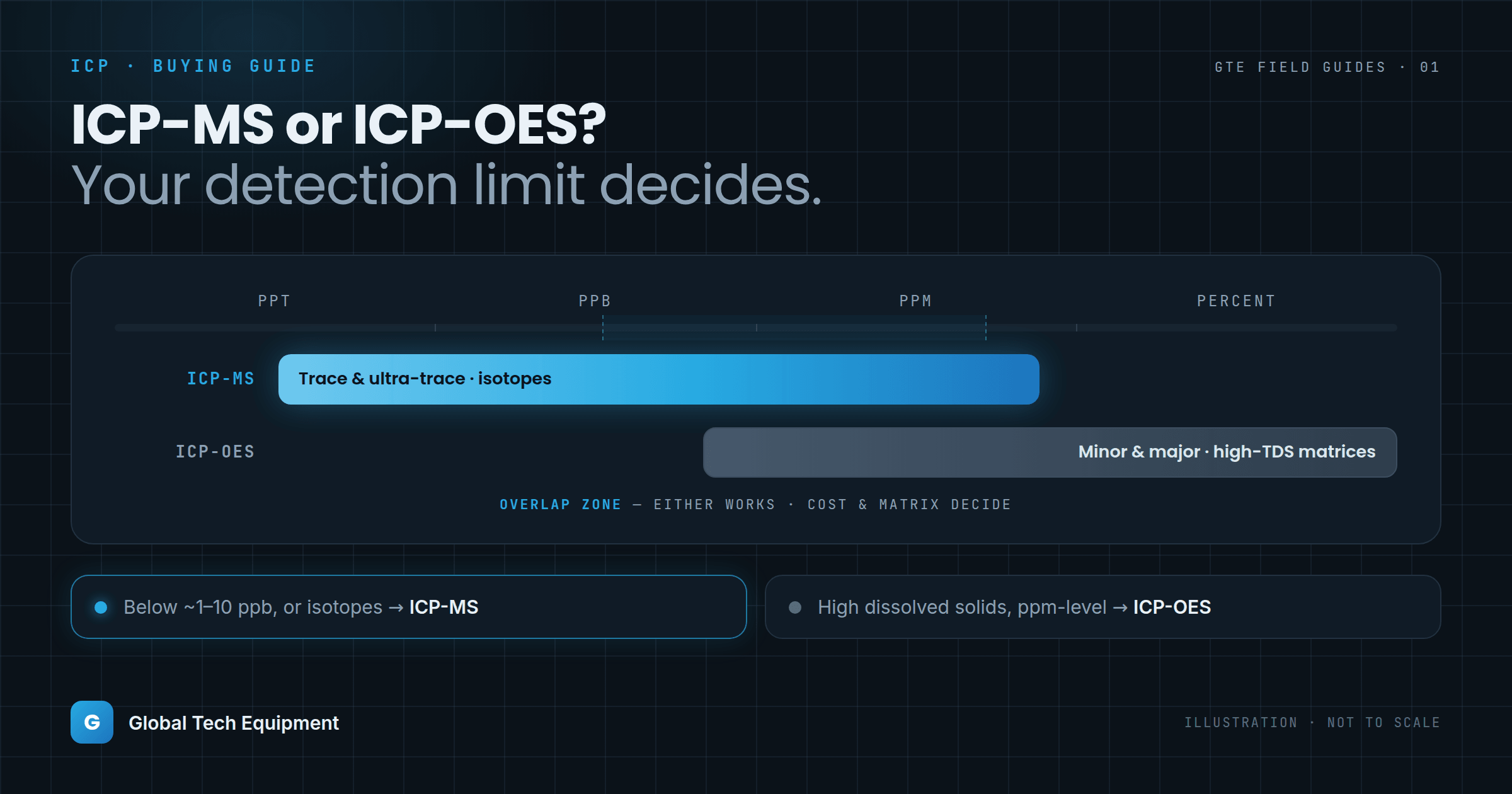
Choose ICP-MS when your reporting limits are below roughly 1–10 ppb, when a regulatory method names it, or when you need isotopes. Choose ICP-OES when your analytes sit at ppm levels, when your samples are dirty or high in dissolved solids, and when you want the simpler, cheaper instrument to own.
If that already settles it, the rest of this guide is detail. If you're on the fence, keep reading — the fence is usually about cost of ownership, not sensitivity.
Side by side
| ICP-OES | ICP-MS | |
|---|---|---|
| What it measures | Emitted light (wavelength) | Ions sorted by mass/charge |
| Typical detection limits | Low ppb (µg/L) | ppt (ng/L) — often 100–1,000× lower |
| Best working range | ppm to percent | ppt to ppm |
| Dissolved solids tolerance | High — routinely 1–3%+ | Low — typically under ~0.2% without aerosol dilution |
| Isotope information | No | Yes — ratios, isotope dilution |
| Main interference type | Spectral line overlap | Polyatomic and isobaric |
| Interference fix | Alternate lines, background/inter-element correction | Collision/reaction cell; triple quad for the hard ones |
| Relative purchase price | Lower | Higher |
| Relative running cost | Lower | Higher — cones, vacuum pumps, detector |
| Operator skill needed | Moderate | Higher |
Choose ICP-MS when…
Your reporting limits are genuinely low. This is the main reason anyone buys one. If you're chasing single-digit ppb or below — drinking water lead and arsenic, trace metals in pharma, ultrapure water, semiconductor materials — ICP-OES will run out of sensitivity and no amount of method work will fix it.
A method mandates it. Regulatory drivers are the cleanest decision-maker of all, because the choice isn't yours:
| Method | Technique | Typical use |
|---|---|---|
| EPA 200.7 | ICP-OES | Metals in water and wastes |
| EPA 200.8 | ICP-MS | Trace metals in water |
| EPA 6010 | ICP-OES | SW-846 solid waste |
| EPA 6020 | ICP-MS | SW-846 trace metals |
| USP ⟨233⟩ / ICH Q3D | Either, if validated | Elemental impurities in pharma |
USP ⟨233⟩ is worth a closer look: it's procedure-agnostic — you can use either technique if you meet the validation criteria. But for the low-limit elements (cadmium, lead, arsenic, mercury), especially on parenteral routes, most labs end up on ICP-MS because OES simply can't reach the limits.
You need isotopes. Isotope ratios, isotope dilution quantitation, or tracer studies are ICP-MS only. OES sees elements, not isotopes.
Sample volume is scarce. Clinical, forensic, and research samples are often measured in microliters. ICP-MS needs less sample to hit a lower number.
You need speciation. Coupling LC to ICP-MS lets you separate arsenic species or chromium (III) versus (VI) — increasingly the regulatory expectation for food and water, since toxicity depends on the species, not just total element.
Choose ICP-OES when…
Your analytes are at ppm or percent levels. Major and minor elements in alloys, ores, fertilizers, cement, plating baths. Putting a percent-level analyte on ICP-MS means diluting it thousands-fold to avoid saturating the detector — you bought sensitivity you then have to throw away.
Your matrices are dirty. This one is underrated. High total dissolved solids — brines, seawater, digested soils, geological samples, spent catalysts — are routine on ICP-OES but will clog an ICP-MS interface and suppress signal. You can manage it with aerosol dilution, but you're adding complexity to solve a problem ICP-OES doesn't have.
You want the simpler instrument. No vacuum system, no cones to erode, no detector to replace on a schedule. Easier to train an operator on, easier to keep running in a production QC lab, less to go wrong at 2 a.m.
Budget matters more than the last decimal. If ppb is enough, ICP-OES gets you there for meaningfully less money — both to buy and to keep running.
The cost of ownership conversation
Purchase price is the part everyone compares, and it's the part that matters least over five years.
Argon is roughly a wash. Both techniques run the plasma at similar flows, typically 15–20 L/min. If argon is your budget worry, that worry applies equally to both, and a liquid argon dewar beats cylinders in either case.
ICP-MS adds consumables ICP-OES doesn't have:
- Sampler and skimmer cones erode and need periodic replacement. Nickel cones are the standard; platinum cones — required for hydrofluoric acid or heavy organic work — cost substantially more.
- Vacuum pumps. A backing/rotary pump and a turbomolecular pump, both wear items with service intervals.
- The detector. Electron multipliers have finite life and are a scheduled replacement, not a surprise.
- Service contracts run higher, simply because there's more instrument to service.
ICP-OES consumables are cheaper and more forgiving: torch, nebulizer, spray chamber, pump tubing. A cracked torch is an annoyance; a damaged ICP-MS interface is a visit.
Ask any seller — including us — for realistic annual consumable and service figures for the specific configuration. It's the number that changes the decision.
When a single quad isn't enough
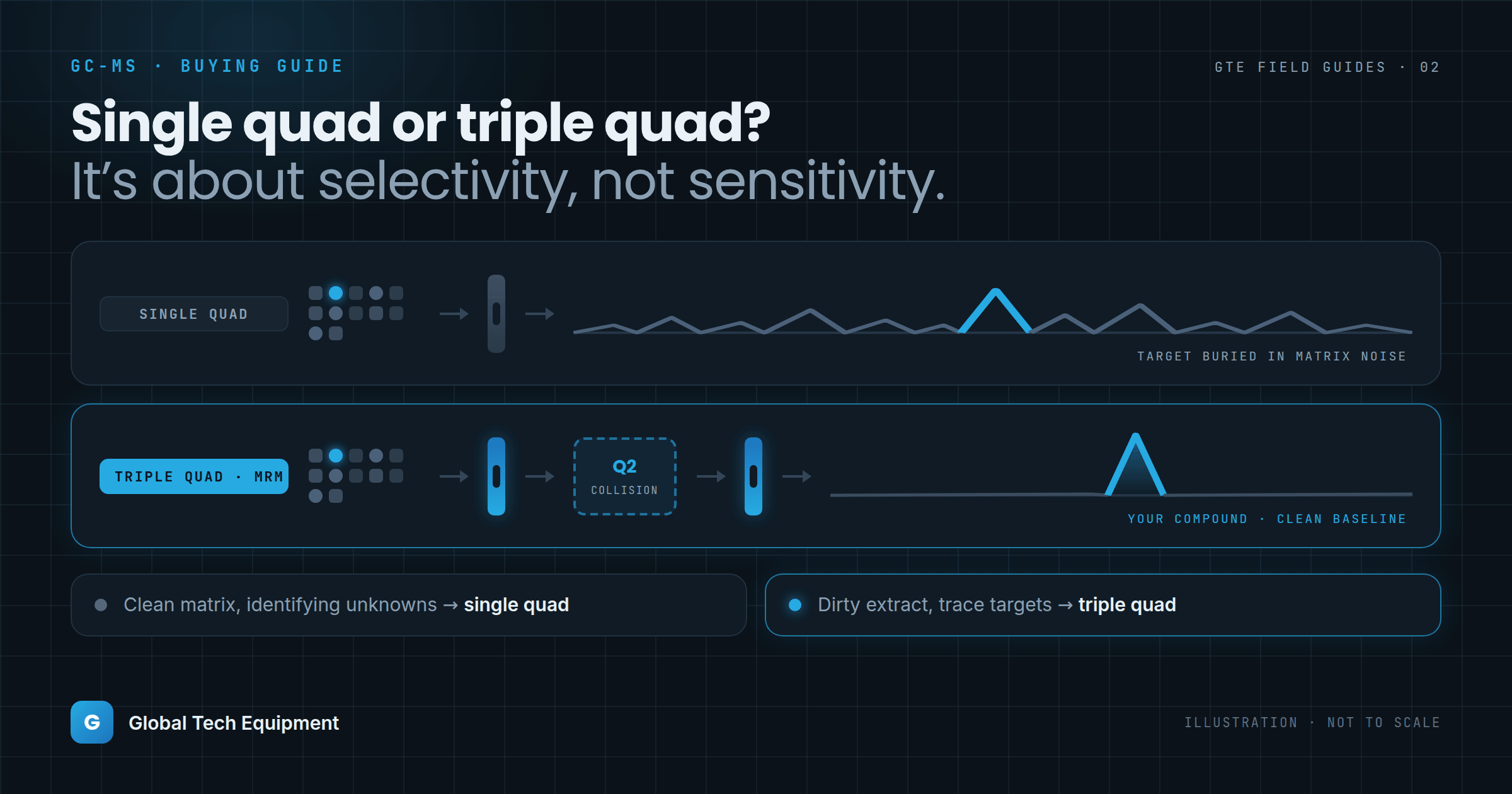
If you're looking at ICP-MS, you'll see single quadrupole and triple quadrupole (ICP-QQQ) instruments. The difference is interference removal.
A single quad with a collision cell (helium kinetic energy discrimination) handles the great majority of routine polyatomic interferences — ArCl on arsenic-75, ArAr on selenium-80, ArO on iron-56. It's enough for most environmental and commercial labs.
A triple quad adds a second mass filter, enabling controlled reaction chemistry and mass-shift methods. It earns its premium on genuinely hard problems: sulfur, phosphorus, and silicon at trace levels; arsenic in high-chloride matrices; selenium at very low limits; titanium in biological matrices. If those aren't your problems, a single quad is the better value.
Many labs end up running both
This isn't a hedge — it's a common and sensible configuration. ICP-OES handles the majors and the dirty, high-TDS samples; ICP-MS handles the traces and the regulated low-limit elements. The two split the workload by concentration range, and each one runs in the regime where it's most robust.
If your sample load spans percent-level and ppt-level analytes, one instrument will always be compromising. Buying one used of each is often less than buying one new of either.
What changes when you buy used
Both techniques reward the same basic diligence — see our companion guide on inspecting a used ICP-OES — but ICP-MS has extra items worth putting in writing before money moves.
Ask about, on any ICP-MS:
- Cone condition and material. Nickel or platinum? Platinum suggests HF or organic solvent history — useful to know, and expensive to replace.
- Vacuum pump hours and service history, for both the backing pump and the turbo.
- Detector age, and the electron multiplier voltage at last tune — it trends upward as the detector ages, so it's a good health indicator.
- What was run on it. Organics, HF, and high-matrix work age an instrument differently than clean aqueous standards.
- Collision/reaction cell gas lines — present, intact, and which gases were plumbed.
On either technique, don't skip these two:
- Software licensing. This is the single most common unpleasant surprise in used instrument purchases. Confirm in writing that the license transfers, which version it is, and whether it runs on an OS you can still support. A working instrument with an untransferable license is a much cheaper instrument than you thought.
- Site requirements. Argon supply, exhaust for the plasma and vacuum pumps, a chiller, stable power, bench space and load rating — and the door widths on the path to the room. Sorting this before delivery avoids the most expensive kind of surprise.
A five-question decision check
- What is my lowest required reporting limit, per element? (Below ~1–10 ppb → ICP-MS.)
- Does a regulatory method name a technique? (If yes, it decided for you.)
- What's the dissolved solids load of my worst routine sample? (High → ICP-OES, or ICP-MS with aerosol dilution.)
- Do I need isotopes or speciation? (Yes → ICP-MS.)
- What's my five-year budget, including consumables and service — not just the purchase price?
Answer those five honestly and the instrument usually picks itself.
Talk it through with us
We buy, sell, and trade both. Tell us your analytes, your limits, and your matrices, and we'll tell you honestly which technique fits — and say so if the answer is the cheaper instrument.
Every system ships inspected and crated to export grade in-house: full custom crates on heat-treated IPPC/ISPM-15 lumber, worldwide.
Browse ICP-MS systems · Browse ICP-OES systems · Ask us a question